The Loudest Problem
A friend asked me to look at his shop before he hands it to his kids. The problem he brought me wasn't the real one. It almost never is.

A friend asked me to look at his shop. The problem he brought me wasn't the one holding it back.
A friend asked me to look at his numbers a couple of weeks ago. He has run a shop for nearly thirty years and he wants to hand it to his daughters one day. He wanted help thinking through the handover.
I said yes before I'd finished reading the message. Which is a little funny, because I spent most of last month telling myself I'm taking on less. But this is the kind of work I actually want more of, not less. Sit down with someone I trust, look at the real thing, find the one part that's actually stuck. So I looked.
Here is what I found, and why almost none of it was about the handover.
The question he brought
His question was clean. Two daughters, one shop, a ten-year runway. How do we move it from me to them without it falling over?
It is a good question. It is also the wrong one, and I only know that because I refused to set a single priority until the numbers were on the table.
Partly that is discipline. Priorities built on a hunch tend to fall over.
But mostly it is because my friend is the kind of operator who moves from one idea to the next at speed, always three moves ahead, full of them.
You cannot rank what matters for someone who is already halfway to the next thing.
So before we talked about anything, I asked for four years of books and actually read them.
What the numbers said
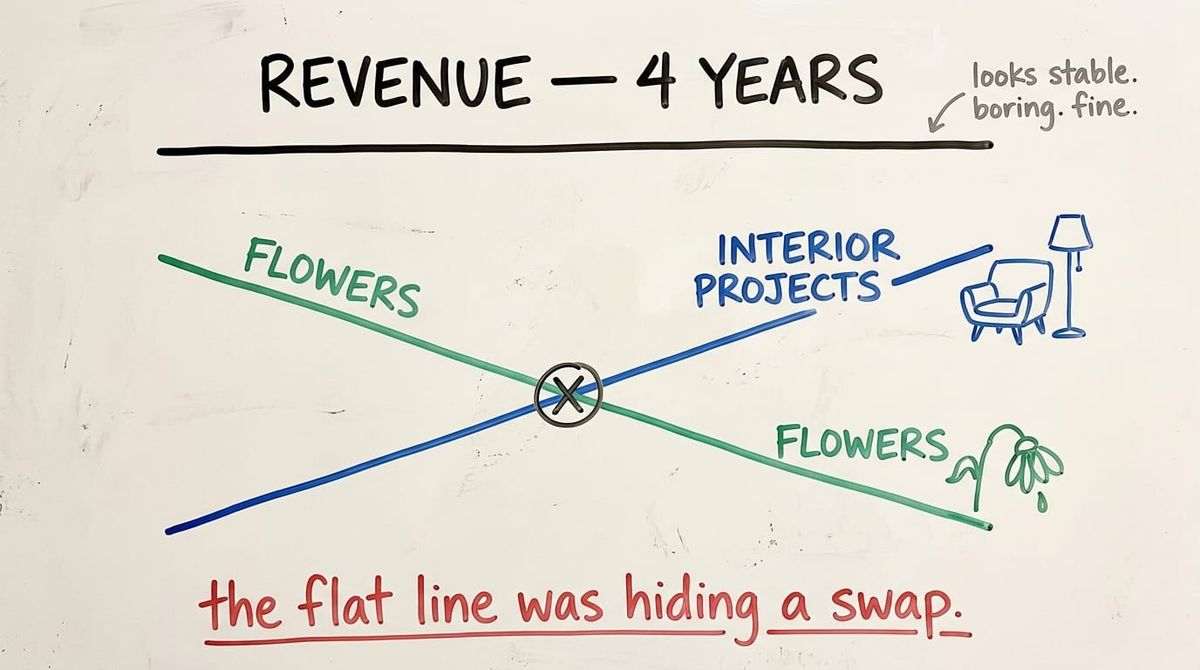
On the surface, nothing was happening. Revenue had sat flat at around four hundred thousand for four years straight. If you only glanced at the top line you'd call it a stable little business coasting toward a handover.
The flat line was hiding a swap.
Over those same four years, flowers more than halved and interior projects more than doubled. The total didn't move because one was quietly replacing the other.
This wasn't a flower shop with a bit of interior on the side. It had become an interior and project business with a flower shop as its window, and nobody had said that out loud, including the owner.
Then the second thing. Roughly two thirds of the revenue was coming from invoiced projects, not shop sales. One good project can be a month's turnover.
That is not a shopkeeper's income, it is a project business's income, and it is lumpy and it leans on a handful of clients.
The "shop I want to hand over" was not really the asset.
The project engine was.
The problem under the problem
Once you see that, the handover question falls apart and a better one takes its place.
It was never "how do we transfer the shop." It was "how do we make the project stream predictable enough that two young people can run it without their father in the room." Different question, different plan.
And under that one sat a harder number. Could the business, at its current size, actually pay the people who were meant to inherit it? Not yet. The money available for salaries had been flat for years, and it did not stretch to the family the plan assumed.
That is not a reason to stop. It is the thing you have to say before you talk about anything else, because it decides what has to grow first.
And under all of that sat the quietest constraint of all, the kind no spreadsheet shows you. Whether the man who built the thing can actually let go of it. In a business like this that is almost always the real bottleneck, and it is the one nobody names first. The numbers were the easy part. That part is the work.
What I'd do, and what we're doing
So we stopped planning a shop handover and started on the real thing.
Reframe it around the project engine, because that is where the money and the future both live. Treat the new website as a window that generates project enquiries, not as a sales channel, and I built a demo store this week to show that rather than argue it. Split the books so the new direction shows up as its own line, because you cannot manage what you cannot see. And sequence the family conversations so the hardest one, the letting go, gets its own room instead of being crammed in next to logistics.
None of this is finished. The session where the family actually decides is still ahead. I might have the pace wrong.
The flowers half falling away is not a mystery, it is less time behind the counter and thinner margins on every stem, and the real open question is whether you rebuild that side or let it wind down on purpose. I would rather leave that one open than answer it fast.
That is fine. The job this month was not to solve it. It was to make sure everyone is solving the right problem before they spend a year on the wrong one.
The thing I keep relearning
Almost every time someone hands me a problem, the one they name is the loudest one, not the real one. The loud one is real enough. It is just sitting on top of a quieter one that is doing the actual damage, and the quiet one rarely announces itself.
A flower shop that has quietly become an interior business. A ROAS that looks great sitting on top of an acquisition problem. A founder who is sure the issue is the agency, when the issue is that nobody has decided what the business is actually for.
Finding that one quiet thing, and saying it plainly, is most of what I do. It is most of what I write about here. And it is the whole job over at heerdenco.com, if you ever want someone to go and find yours.
Still looking. One layer down, most of the time.
The Real Account is the honest version of this work. No hype, no playbook. If this was useful, I'm on LinkedIn, and I help founder-led brands find the one constraint holding their marketing back at heerdenco.com.