Outsourced Thinking

Start here. What I believe, what I do, and what I will not do.
For six years I ran a business that got paid when the answer was more ads.
I want to be careful with that sentence, because it sounds like a confession and it is only half of one.
We did good work.
Some of the best accounts I have ever seen were built in that office, and the people running it today are better at the day-to-day than I ever was. But the model has a shape. A founder hands you one piece of the machine, you make that piece run as well as it can, and you get paid as long as the piece keeps running. Nobody is dishonest. The incentive just points one way, and it does not point at the question the founder actually has.
That question is almost never "how do I get more out of this channel." It is "why does this feel capped when everything is green." You cannot answer it from inside one channel, because the answer usually sits somewhere else.
What I kept seeing
The thing that finally moved me was not a bad client or a lost account. It was the same conversation, over and over, with founders of good companies.
A founder with four agencies, each optimising their own corner, wondering why the whole felt incoherent. He tried to get them to sit at one table. Then he understood he was the table.
A brand whose ads were working, genuinely working, and whose customers ordered 1.08 times on average. The front door was fine. Nobody had walked around to the back.
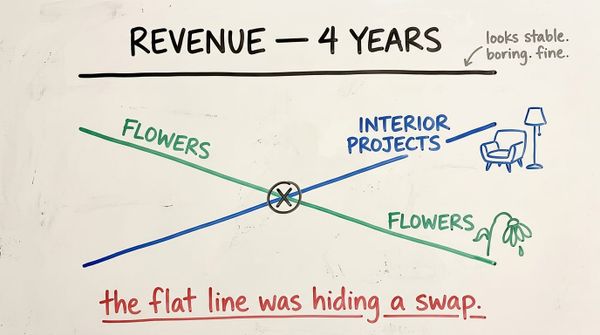
A shop that had quietly been turning into a different business for four years while the top line sat flat, and an owner who wanted help with a handover that was not the problem.
Different companies, sizes and industries. Same structure underneath. In every one of them the thinking had been outsourced. Not the work. The thinking. Strategy sat with the agency, measurement sat with the tool vendor, priorities sat with whoever had the loudest dashboard that month, and the person who owned the business was left coordinating suppliers instead of running a system.
That is what I am building against. Outsourced thinking.
Why I am not against agencies
This matters to me, so I will say it plainly. I built one, and I am proud of it. Some of the best operators I know run one.
The agency is not what is wrong. What is wrong is that nobody on the client's side holds the whole picture, and that hurts the agency too. When nobody inside the company knows what the one metric is, what the constraint is, what comes next, the agency ends up guessing at strategy in the gaps between briefs. They get blamed for outcomes they never controlled. Everyone underperforms, agency included.
So the honest version of what I do is this: I make your agency better, not redundant. When the team that briefs them knows what it is doing, the agency gets better briefs, cleaner numbers, and a client who can tell a good month from a good system.
What I do
I install marketing operating systems in founder-led companies, and then I leave.
The system has five layers and none of them are exotic. Signal you can trust. One metric that actually matters. A funnel that converts. Activation that compounds. A weekly cadence that survives a busy month. Most companies already have all five in some form. Most have two that work and three that are noise. The job is to find which layer is actually holding the business back, fix that one, and hand the controls to the people who already work there.
Notice what is missing from that paragraph. More ads. More content. Another tool.
When I look at a company that feels stuck, the answer is almost always fewer moving parts pointed at one thing, not more parts pointed at everything.
Taking something away usually does more than adding something. I learned that the expensive way, by building.
My own graveyard is full of tools I built and used exactly once, dashboards nobody opened twice, and workflows I binned after three failed runs. The things that lasted were the ones that removed a step.
What I believe
Three things. I would rather write them down here than find out later that I drifted.
Truth over revenue. Sometimes the finding is that marketing is not your problem. I would rather tell you that and lose the project than sell you a fix for the wrong thing. The guarantee on the Blueprint says this in contract form: I name your biggest constraint or you do not pay.
Systems over muscle. No hero dependency. Not on your best employee, and not on me. If the thing only works while I am in the room, I have built you a dependency, not a system.
Lean by design. A small team, with AI in the engine room and never in the headline. Not as a cost saving. As a choice about what kind of company is pleasant to run, and pleasant to work with.
What I will not do
These sit on the Blueprint page as house rules. They belong here too, because a set of beliefs without a no-list is a slogan.
I will not run your ads. That stays with an agency, yours or one I trust.
I will not take it over. Your team keeps the controls. That is the entire point.
I will not start with a retainer. Everyone starts with the Blueprint. Nobody gets an ongoing role in your company before we both know what the constraint is.
I will not diagnose for free. The twenty-minute call is to find out whether we fit. The diagnosis is the work, and giving it away in the first call is the fastest way I know to be wrong about it.
That last one cost me the most to write down. I like being useful in the first conversation. But an opinion after twenty minutes is a guess with confidence, and I have watched guesses like that cost people a year.
Why I do this
There is a personal version too, and it belongs here more than on a company website.
I have four kids and eighteen years in one channel. The work that gave me energy drifted away from the work I was paid for, slowly enough that I did not notice for a long time. What I actually love is sitting with someone who trusts me, reading the real numbers, and finding the one quiet thing under the loud one. Then saying it plainly and helping their people fix it. I do not need to be the one who runs it afterwards. I would rather not be.
Heerden & Co is that, turned into a company. Small on purpose. Built for founder-led businesses between roughly half a million and ten million, ecommerce and B2B, the size where the founder is still the person the business runs through, and where one fixed constraint moves everything.
Where to go from here
If you are new here, three pieces show the work better than any description of it.
The Loudest Problem is the shop with the flat top line, and the handover that was not the problem.
The Customers Who Never Came Back is the brand with working ads and a back door nobody checked.
Twelve Days Dark is the personal one, about whether I could actually let go of the company I built.
If your growth feels busy but stuck, that is usually the constraint talking. The plain version of what I do is at heerdenco.com. The honest version is here, every week or so.
Still one layer down. Now with a name on the door.
The Real Account is the honest version of this work. No hype, no playbook. If this was useful, I'm on LinkedIn, and I help founder-led brands find the one constraint holding their marketing back at heerdenco.com.